Context
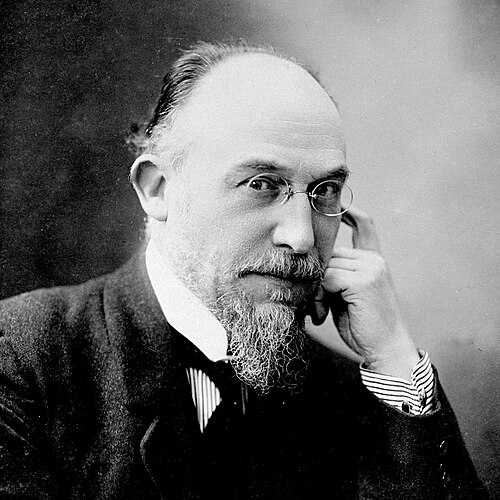
Satie composed the first Gnossiennes at the beginning of the 1890s, in the years when he played the piano at the Le Chat Noir cabaret in Montmartre; he invented the word himself, perhaps with an allusion to gnosis or to Knossos, in Crete. Written without bar lines or conventional tempo indications, they carry instead remarks such as “very brilliant” or “from the tip of the thought”.
The first and third turn on melodies of oriental character, with exotic scales that Satie may have heard at the Exposition Universelle in Paris in 1889, over an accompaniment of motionless chords. There is no development or climax: the music repeats and varies, and creates an effect of suspension that anticipates ideas which Debussy, Ravel and the minimalists of the twentieth century would develop. Together with the Gymnopédies, they are his most performed music.
Score
- Source
- Mutopia Project
- Licence
- CC BY-SA 4.0
‘Gnossienne No. 1’, edited by Knute Snortum for the Mutopia Project (from EDITIONS SALABERT, 22, Rue Chauchat. Paris, 1913), Creative Commons Attribution-ShareAlike 4.0. https://www.mutopiaproject.org/cgibin/piece-info.cgi?id=2035 · ‘Gnossienne No. 3’, edited by Frédéric Duperray for the Mutopia Project (from Paris : Rouart, Lerolle & Cie., 1913. Plates R.L. 9884-9886 & Cie. Possibly scanned from the Dover reprint.), Creative Commons Attribution-ShareAlike 4.0. https://www.mutopiaproject.org/cgibin/piece-info.cgi?id=2131
Gregory Tait
- Duration
- 8 min
- Source
- Gregory Tait
- Archive
- Internet Archive
- Licence
- CC BY 4.0