Context
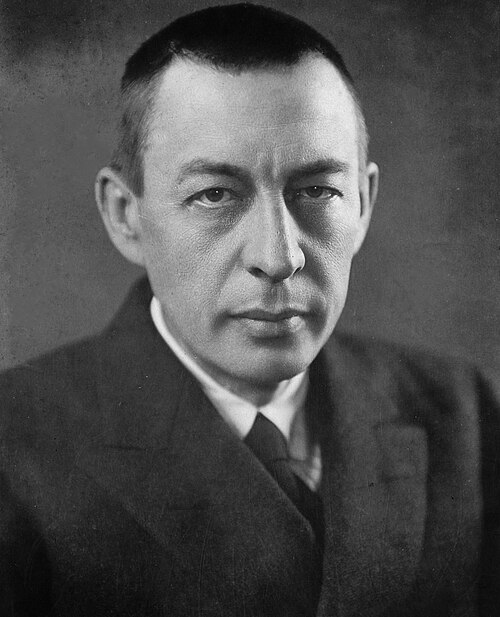
The initials in the title are those of Vasily Rachmaninoff, the composer’s father, who used to play this polka at the piano. Rachmaninoff believed it to be his father’s work, but the melody comes from a polka by the German composer Franz Behr, one of those light pieces that circulated in nineteenth-century salons. In 1911 Rachmaninoff turned it into a concert piece and dedicated it to the pianist Leopold Godowsky, famous for his paraphrases of extreme difficulty.
The arrangement keeps the cheerful tone of the original and covers it with countermelodies, inner voices, leaps and chromatic harmonies that take it far from the ballroom. Rachmaninoff often played it as an encore and recorded it several times. It belongs to the repertoire of transcriptions with which he accompanied his own music, like his arrangement of the Scherzo from A Midsummer Night’s Dream by Mendelssohn.
Sergei Rachmaninoff
- Duration
- 4 min
- Source
- Onkel Greifenklau
- Archive
- Internet Archive
CD 7 of the complete Rachmaninoff recordings (RCA), transferred from the original 78s and LPs. His own transcriptions (Bach, Mendelssohn) and Russian pieces (1923-42).
Sergei Rachmaninoff
- Duration
- 4 min
- Source
- Onkel Greifenklau
- Archive
- Internet Archive
CD 10 of the complete Rachmaninoff recordings (RCA), transferred from the original 78s and LPs. The earliest recordings: Edison (1919) and Victor (1920-23).
Sergei Rachmaninoff
- Duration
- 4 min
- Source
- Onkel Greifenklau
- Archive
- Internet Archive
CD 10 of the complete Rachmaninoff recordings (RCA), transferred from the original 78s and LPs. The earliest recordings: Edison (1919) and Victor (1920-23).