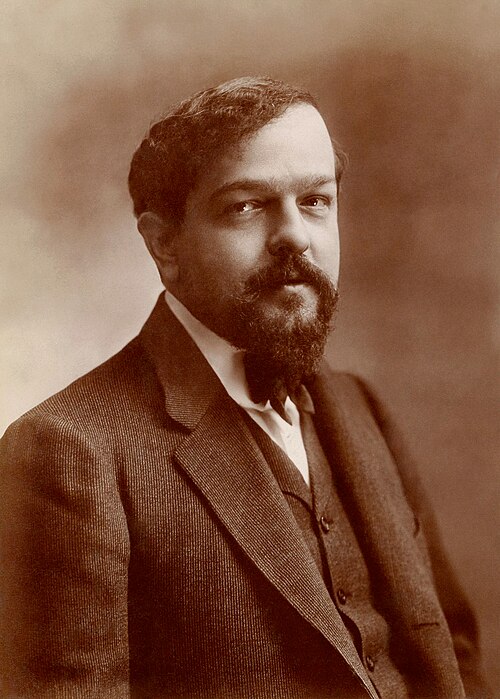
Context
They are among the first piano pieces Debussy published, at the beginning of the 1890s, when he had not yet found the language of the Prélude à l’après-midi d’un faune. The legacy of Massenet and the French salon can still be felt in them, but the title already points to his idea of music: a decorative line that curves and folds back on itself, like the arabesques of the art he admired.
The first, in E major, unfolds fluid triplets passing from one hand to the other over harmonies of fifths and sixths without classical tension. The second, in G major, is lighter and more playful, with trills and quick figures. Because of their moderate difficulty they became standard repertoire for students and one of the best-known pieces of Debussy’s music.
Score
- Source
- Mutopia Project
- Licence
- CC BY-SA 4.0 and Public domain
‘Première Arabesque’, edited by Keith OHara for the Mutopia Project (from Durand et Fils (1904)), public domain. https://www.mutopiaproject.org/cgibin/piece-info.cgi?id=1777 · ‘Deuxième Arabesque’, edited by Knute Snortum for the Mutopia Project (from Paris: Durand et Schoenewerk, n.d.[1891]. Plates D.S. 4395-96), Creative Commons Attribution-ShareAlike 4.0. https://www.mutopiaproject.org/cgibin/piece-info.cgi?id=1994
José Iturbi
- Duration
- 7 min
- Source
- Transfer by Bob Varney
- Archive
- Internet Archive
- Licence
- Public domain (dedication)
Recording of 1946.