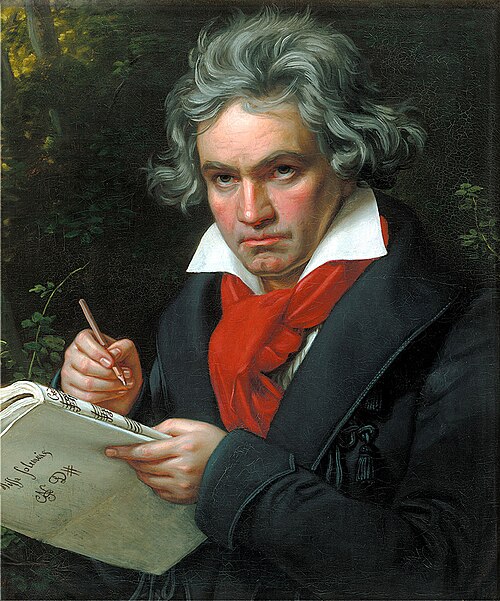
Context
It was first performed on 2 April 1800 at the Burgtheater in Vienna, at the first public concert Beethoven organised for his own benefit, alongside his Septet and works by Haydn and Mozart. He dedicated it to Baron Gottfried van Swieten, the patron who had introduced the music of Bach and Handel to Vienna.
The opening was a provocation: instead of affirming the key of C major, the symphony begins with a dissonant chord leading to F major, and takes several bars to find its tonic. The third movement is called a minuet, but its fast tempo makes it a scherzo, the type of movement that will occupy that place in his later symphonies. The finale begins with a joke: the violins feel their way up a scale that lengthens note by note before launching the theme. It is a symphony on a classical scale, like Haydn’s London symphonies, among them No. 104, but with a more prominent role for the wind instruments.
Score
- Source
- Wikimedia Commons
- Licence
- Public domain
Berliner Philharmonisches Orchester, Hans Pfitzner
- Duration
- 22 min
- Source
- Onkel Greifenklau
- Archive
- Internet Archive
Six sides of 78 rpm from 1928; Pfitzner, the composer, conducting Beethoven.