Context
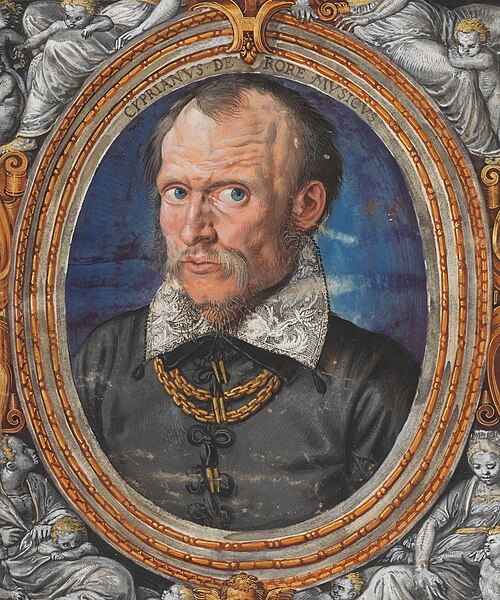
Cipriano de Rore, Flemish by training and one of the most influential madrigalists of the sixteenth century, was maestro di cappella at the court of Ferrara for Duke Ercole II d’Este. For him he wrote this seven-voice Mass based on the motet Praeter rerum seriem by Josquin des Prez, who had served at the same court half a century earlier.
Rore takes the material of Josquin’s motet and reworks it in each section of the Mass, the technique known as parody, but adds a voice that sings a text in honour of the duke, “Hercules the Second, fourth Duke of Ferrara, lives and will live”, as a cantus firmus in long notes. The Agnus Dei is the section that closes the Mass. The work shows how the polyphonic Mass served at once the liturgy and the display of a prince’s power.
The Tudor Consort
- Duration
- 8 min
- Source
- The Tudor Consort
- Archive
- Internet Archive
- Licence
- CC BY 3.0
Wellington chamber choir (New Zealand) that publishes its concerts under CC BY on the Free Music Archive; mirrored on the Internet Archive. Tour programme: ten Renaissance motets and madrigals, one per composer.