Context
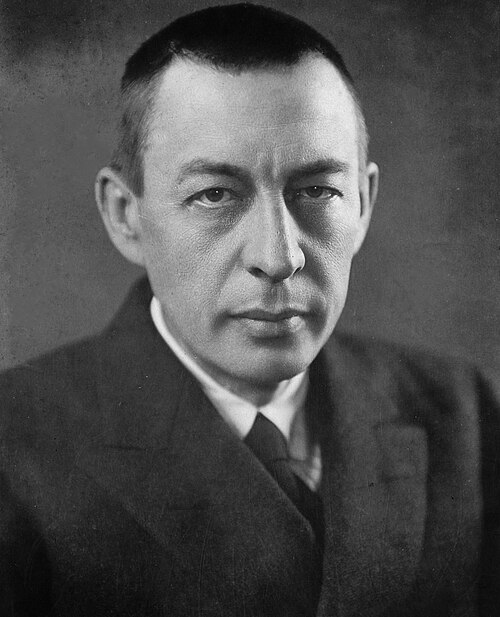
Rachmaninoff first played it in public in Moscow in 1892, at the age of nineteen, and published it that same year as the second of the five pieces of the Morceaux de fantaisie. It soon became its composer’s most famous work. Russia had not signed the international copyright conventions, so foreign publishers printed it freely, often under invented titles, and Rachmaninoff earned almost nothing from its success.
The piece is in ternary form. It opens with three low notes in fortissimo, followed by chords in three layers that sound like bells. The central section, Agitato, speeds up in triplets and leads to the return of the theme, now on four staves. Audiences asked for it at all his recitals, and the composer grew tired of playing it. He later completed, with Opp. 23 and 32, a cycle of preludes in all twenty-four keys.
Score
- Source
- Mutopia Project
- Licence
- CC BY-SA 4.0
‘Prelude in C# minor’, edited by Petro Kostandy for the Mutopia Project (from Bosworth & Co. 1896; Universal Edition 1910), Creative Commons Attribution-ShareAlike 4.0. https://www.mutopiaproject.org/cgibin/piece-info.cgi?id=2033
Sergei Rachmaninoff
- Duration
- 4 min
- Source
- Onkel Greifenklau
- Archive
- Internet Archive
CD 7 of the complete Rachmaninoff recordings (RCA), transferred from the original 78s and LPs. His own transcriptions (Bach, Mendelssohn) and Russian pieces (1923-42).
Sergei Rachmaninoff
- Duration
- 4 min
- Source
- Onkel Greifenklau
- Archive
- Internet Archive
CD 10 of the complete Rachmaninoff recordings (RCA), transferred from the original 78s and LPs. The earliest recordings: Edison (1919) and Victor (1920-23).
Sergei Rachmaninoff
- Duration
- 4 min
- Source
- Onkel Greifenklau
- Archive
- Internet Archive
CD 10 of the complete Rachmaninoff recordings (RCA), transferred from the original 78s and LPs. The earliest recordings: Edison (1919) and Victor (1920-23).