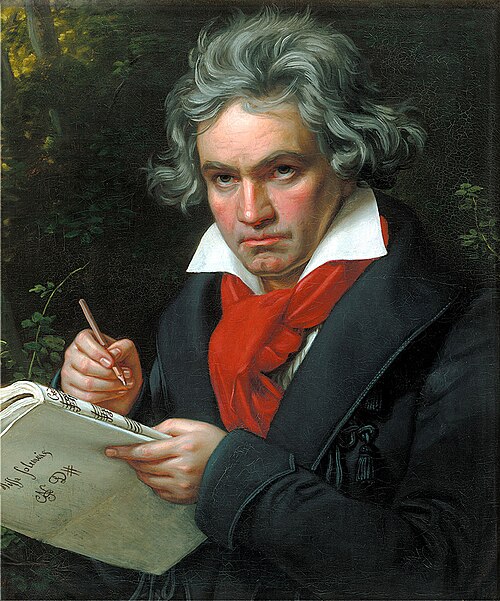
Context
Beethoven held it in high esteem and told his publisher Hoffmeister so; Hoffmeister published it in 1802 with a dedication to Count Johann Georg von Browne. It is the last of his sonatas that faithfully follows the classical four-movement model; immediately afterwards come those of Op. 26 and the two quasi una fantasia sonatas of Op. 27, in which he begins to dismantle it.
The opening allegro con brio has an almost symphonic drive, with scales and octaves that range over the whole keyboard. The adagio con molta espressione, in E flat, is a cantilena of measured pace in 9/8 that recalls an operatic aria. A traditional minuet follows with an agitated trio in G minor, and a final rondo of amiable tone that grows more complicated in its central section with a contrapuntal episode. It is a mature work of the first style, of controlled virtuosity, played less than its neighbours because it has no gesture that makes it famous.
Score
- Source
- Wikimedia Commons
- Licence
- Public domain
Artur Schnabel
- Duration
- 24 min
- Source
- Onkel Greifenklau
- Archive
- Internet Archive
Volume 3 of the first complete cycle of the sonatas ever recorded (HMV / Beethoven Sonata Society, 1932-35). Sonatas 9, 10, 11, 12.
Daniel Veesey
- Duration
- 28 min
- Source
- Daniel Veesey · Musopen
- Archive
- Internet Archive
- Licence
- Public domain (dedication)
Beethoven sonatas commissioned by Musopen from Daniel Veesey (2008) and published as public domain; this is the Free Music Archive mirror on the Internet Archive, with the public-domain dedication declared by the pianist himself.