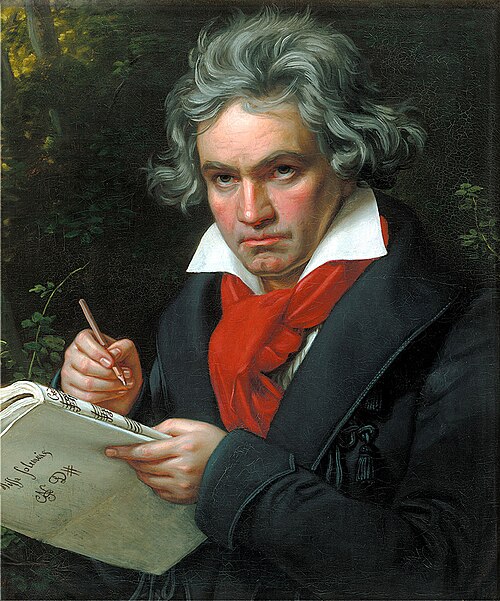
Context
It is the oldest of Beethoven’s published piano concertos. The first sketches date from his years in Bonn, and he revised it several times in Vienna until it reached its definitive form in 1798; the publisher Hoffmeister issued it in 1801, shortly after what we now call Concerto No. 1. Along the way it lost its original finale, which survives separately as the Rondo WoO 6.
The orchestra is small, without clarinets, trumpets or timpani, and the Mozartian model shows in the clarity of the textures and in the division of roles between soloist and tutti. But there are features of its own: the adagio in E flat ends with a recitative for the piano, marked with sustained pedal, which sounds almost like a confidence, and the final rondo has off-beat accents that anticipate the abrupt humour of the mature Beethoven. It was his calling card as pianist and composer in Vienna in the mid-1790s.
Score
- Source
- Wikimedia Commons
- Licence
- Public domain
Artur Schnabel, London Symphony Orchestra, Malcolm Sargent
- Duration
- 28 min
- Source
- Onkel Greifenklau
- Archive
- Internet Archive
From the cycle of the five concertos with Sargent (HMV, 1932-35), transferred from the Historia H 650 box set.