Context
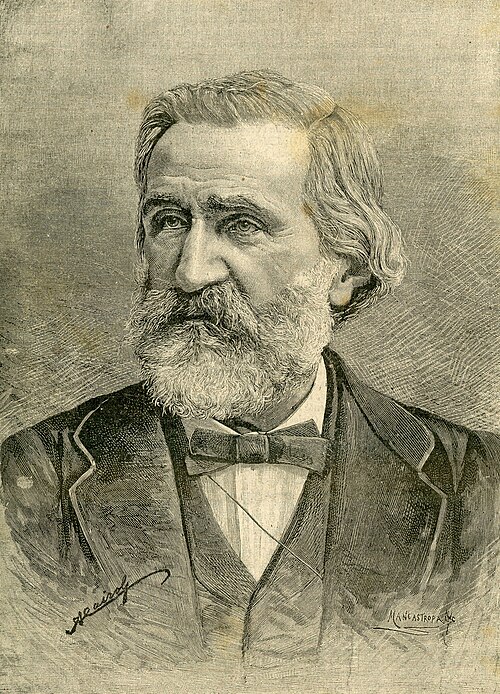
After Rossini’s death, in 1868, Verdi proposed a collective requiem by Italian composers and wrote the “Libera me” for it. When Alessandro Manzoni died, on 22 May 1873, he decided to compose an entire requiem in his memory and took up that page again as its finale. He conducted it himself in the church of San Marco in Milan on 22 May 1874, the first anniversary of the writer’s death, with Teresa Stolz among the soloists, and three days later at La Scala.
Written for four soloists, chorus and orchestra, it has its dramatic centre in the “Dies irae”, with its off-beat strokes on the bass drum. From the premiere it was reproached for being too operatic in style, and today it is almost always performed in concert; the musicologist David Rosen considers it perhaps the most frequently performed choral work composed since Mozart’s Requiem. Tullio Serafin recorded it in Rome in 1939 with Maria Caniglia, Ebe Stignani, Beniamino Gigli and Ezio Pinza.
Maria Caniglia, Ebe Stignani, Beniamino Gigli, Ezio Pinza, Orchestra e Coro del Teatro Reale dell'Opera di Roma, Tullio Serafin
- Duration
- 1 h 15 min
- Archive
- Wikimedia Commons
- Licence
- CC BY-SA 4.0
Grabado en Roma en 1939 y publicado por La Voce del Padrone en diez discos de 30 cm (20 caras); coro preparado por Giuseppe Conca. Digitalizado por el ICBSA (antigua Discoteca di Stato), que publicó las caras en Commons con licencia CC BY-SA 4.0.