Context
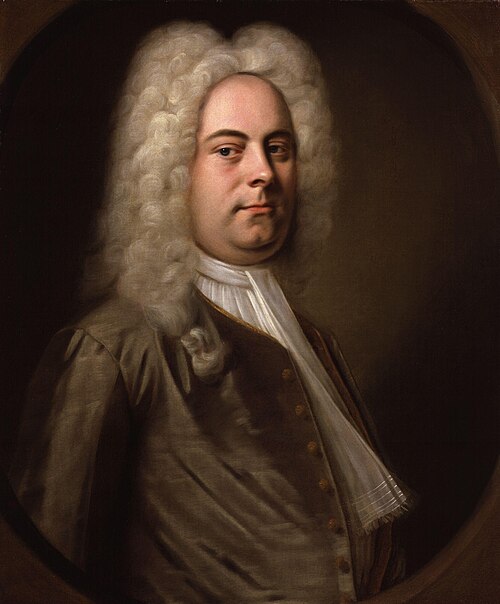
Handel composed the score in about three weeks, between August and September 1741, to a libretto that Charles Jennens compiled from the King James Bible and the Book of Common Prayer. Unlike his other oratorios, it has no characters and no action: in three parts it surveys the prophecy and birth of Christ, the Passion and the Redemption.
It was first performed in Dublin on 13 April 1742, at a charity concert. In London it was slow to establish itself, but from 1750 Handel conducted it every year for the benefit of the Foundling Hospital, and it became the most performed oratorio in the English repertoire. Arrangements followed, such as Mozart’s in 1789, and editions for enormous choirs. The great Handel commemorations in London impressed Haydn, who afterwards wrote The Creation. The recording is by Hermann Scherchen with the London Symphony Orchestra, from 1953.
Score
- Messiah-a4201 pp.
- Bassi42 pp.
- Keyboard75 pp.
- Oboe 143 pp.
- Oboe 243 pp.
- Tromba 15 pp.
- Tromba 25 pp.
- Tympani4 pp.
- Viola29 pp.
- Violino 143 pp.
- Violino 243 pp.
- Violino 343 pp.
- Vocal94 pp.
- Keyboard178 pp.
- Source
- Mutopia Project
- Licence
- CC BY 3.0
‘Messiah’, edited by Nicolas Sceaux for the Mutopia Project (from Leipzig, Friedrich Chrysander, Deutschen Handelgesellschaft edition, volume 45, 1902), Creative Commons Attribution 3.0. https://www.mutopiaproject.org/cgibin/piece-info.cgi?id=1732
Margaret Ritchie, Constance Shacklock, William Herbert, Richard Standen, London Philharmonic Choir, London Symphony Orchestra, Hermann Scherchen
- Duration
- 2 h 52 min
- Source
- Hermann Scherchen
- Archive
- Internet Archive