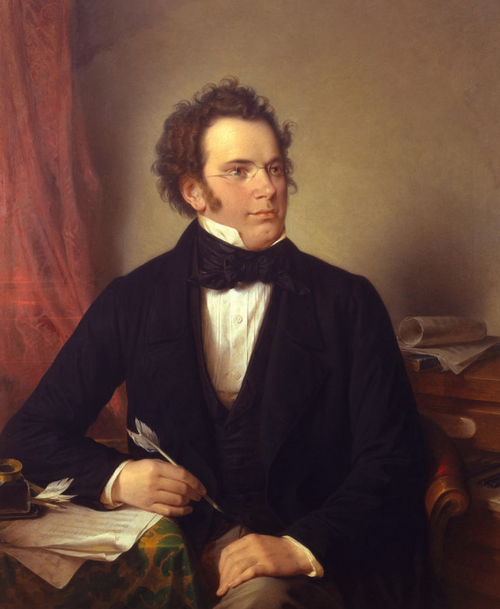
Context
It is the second of the three that Schubert composed in September 1828, two months before he died, together with D. 958 and D. 960; all three were published in 1839.
The opening Allegro combines solemn chords with figures of great mobility, and the Andantino in F sharp minor is one of Schubert’s most singular movements: a barcarolle melody that breaks, in its central section, into an episode of almost chaotic tone, with trills, scales and violent chords, before returning to the opening theme. A light scherzo follows, and a final rondo whose design, as Charles Rosen pointed out, closely follows that of the finale of Beethoven’s Sonata Op. 31 No. 1, who had died barely a year earlier. The rondo theme derives from the Andante of the earlier A minor sonata, D. 537.
Paul Pitman
- Duration
- 38 min
- Source
- Musopen
- Archive
- Internet Archive
Recordings from the Musopen Kickstarter (2010): Czech National Symphony Orchestra, Musopen String Quartet, Shelley Katz and Paul Pitman. Musopen dedicated them to the public domain worldwide.