Context
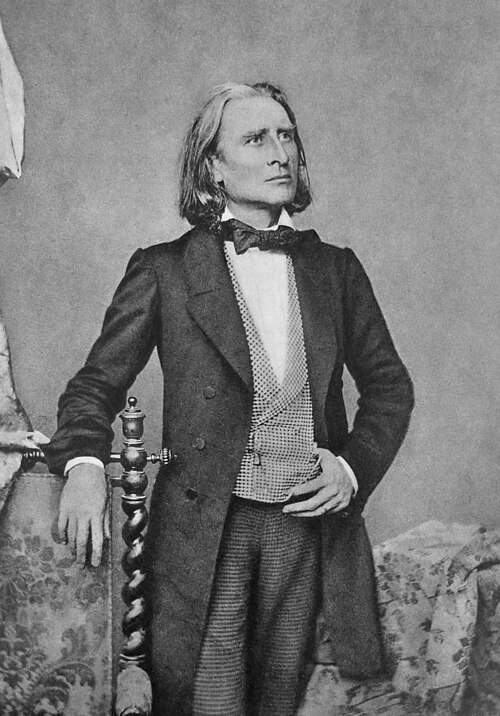
The three Liebesträume (Dreams of Love) that Liszt published in 1850 are piano versions of songs of his, presented as nocturnes. The first two start from poems by Ludwig Uhland on mystical love and love in the face of death; the third from a poem by Ferdinand Freiligrath, O lieb, so lang du lieben kannst (Love as long as you can love), on earthly love and the urgency of loving before loss arrives.
The melody appears first in the middle register, surrounded by arpeggios shared between the two hands, and returns twice more, transformed, separated by virtuoso cadenzas. It is Liszt’s most popular piece after the Hungarian Rhapsody No. 2. On the website there are two recordings from the acoustic era, by the Russian-British pianist Mark Hambourg (1916) and by Wilhelm Backhaus (1923), and a cello arrangement that Pablo Casals recorded in 1914.
Score
- Source
- Wikimedia Commons
- Licence
- Public domain
Mark Hambourg
- Duration
- 3 min
- Source
- Onkel Greifenklau
- Archive
- Internet Archive
Wilhelm Backhaus
- Duration
- 4 min
- Source
- Public Domain Project
- Archive
- Wikimedia Commons
- Licence
- Public domain (dedication)
Recorded in London on 15 October 1923 (HMV D 788).