Context
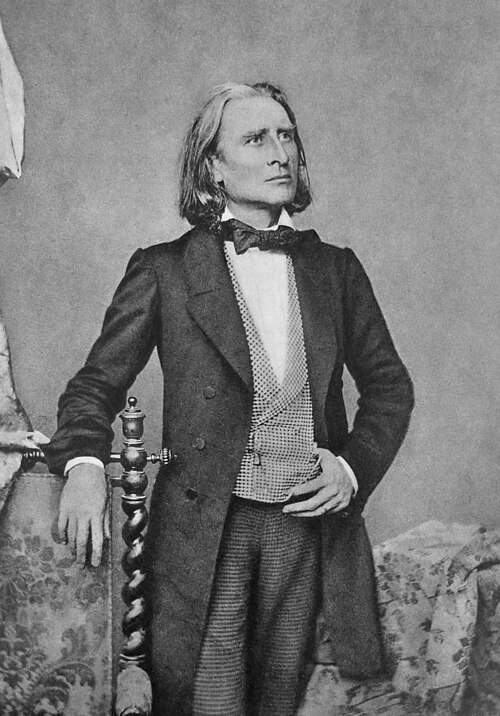
Liszt wrote this organ work in the winter of 1850, in Weimar, on the Anabaptist chorale from the first act of Le prophète, Meyerbeer’s opera first performed the previous year in Paris, and dedicated it to the composer. It was first performed in 1852 and the revised version was played by Alexander Winterberger in 1855 in Merseburg Cathedral.
It lasts nearly half an hour and has three parts: a fantasia that states the chorale and transforms it, a central adagio and a great fugue that serves at once as recapitulation and finale. Liszt treats the organ as an orchestra and applies the same thematic transformation as in his symphonic poems. It is one of the central works of the Romantic organ repertoire; Busoni transcribed it for piano in 1897. It is played by Victor-Antonio Agura on the Klais organ of the church of St. Clemens in Dortmund-Hombruch.
Score
- Source
- Internet Archive
- Edition
- Leipzig: Breitkopf & Härtel, n.d.(1852). Plate 8328.
- Licence
- Public domain
Victor-Antonio Agura (órgano)
- Duration
- 32 min
- Source
- Victor-Antonio Agura
- Archive
- Wikimedia Commons
- Licence
- CC BY-SA 4.0
On the Klais organ of St. Clemens, in Dortmund-Hombruch; published by the organist under a CC BY-SA licence.