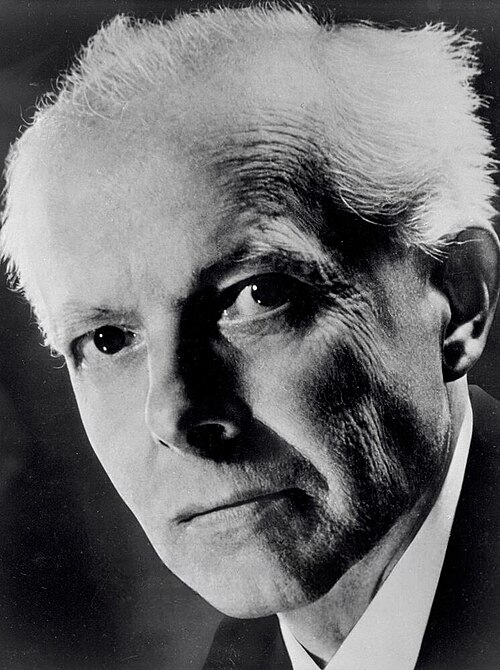
Context
Bartók had been in exile in the United States for three years and was in hospital, ill with what was later found to be leukaemia, when Serge Koussevitzky came to see him in 1943 to commission a work on behalf of his foundation; Fritz Reiner, a fellow student of his in Budapest, and Joseph Szigeti had promoted the commission. The score bears the dates 15 August to 8 October 1943, and Koussevitzky premiered it with the Boston Symphony on 1 December 1944.
Bartók called it a concerto because it treats each section of the orchestra as a soloist. In the second movement pairs of instruments parade past, each at a different interval; the Elegia is night music, and the Intermezzo interrotto interrupts its melody with a quotation from Lehár’s The Merry Widow that Shostakovich had just used in his Symphony No. 7, “Leningrad”. Reiner made the first recording with the Pittsburgh Symphony on 4 and 5 February 1946, a few months after Bartók’s death.
Pittsburgh Symphony Orchestra, Fritz Reiner
- Duration
- 37 min
- Archive
- Internet Archive
- Licence
- Public domain (dedication)
Primera grabación de la obra, hecha por Reiner para Columbia en Pittsburgh en 1946, un año después de la muerte de Bartók.